
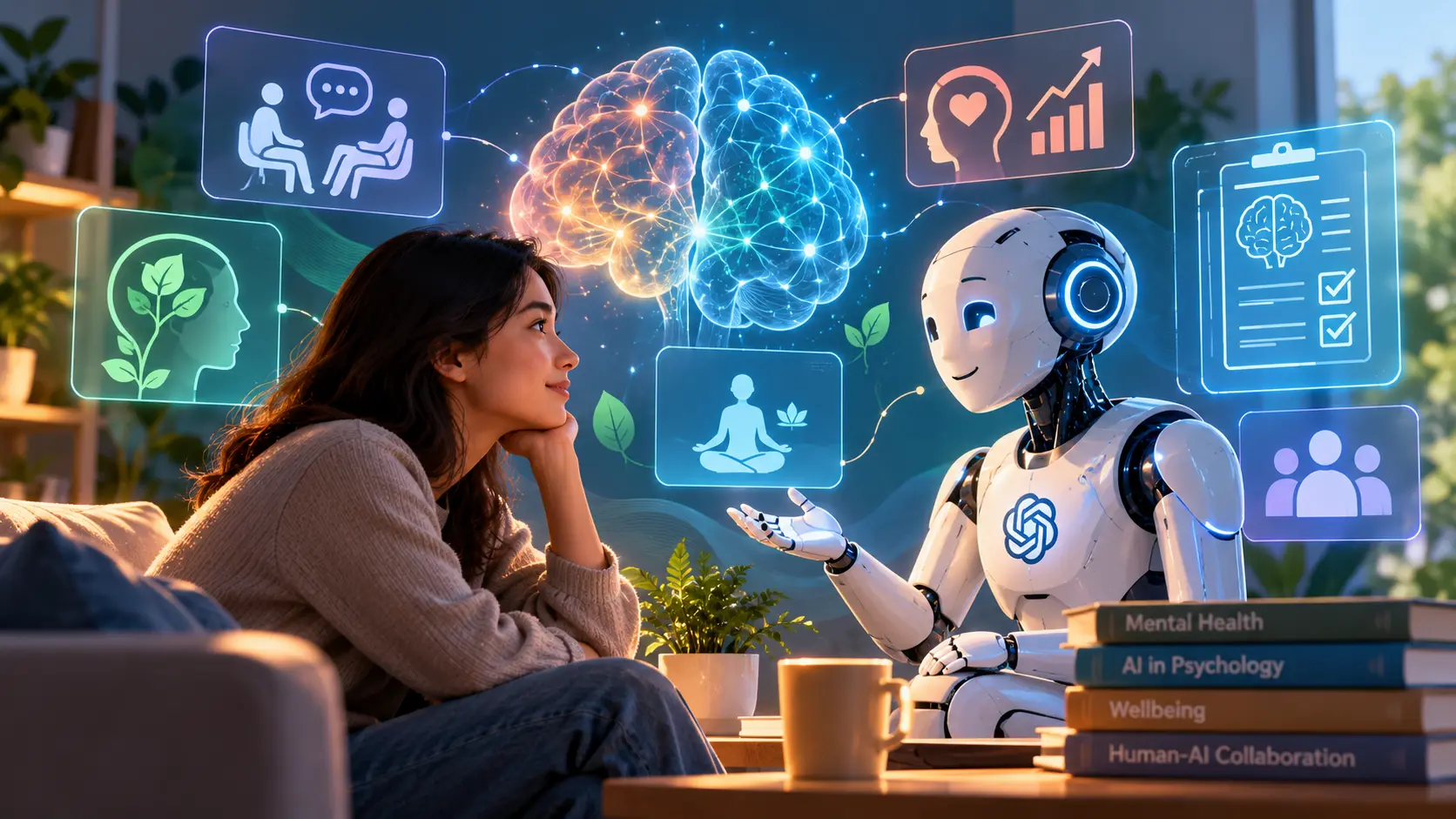
AI in psychology is no longer a distant possibility. It is already reshaping how researchers study the mind, how therapists treat patients, and how the entire field thinks about what makes human cognition unique. From analyzing decades of research papers in minutes to powering chatbots that deliver therapy, artificial intelligence is touching nearly every corner of the discipline, and psychologists themselves are divided on whether that is something to celebrate or approach with caution.
How AI in Psychology Is Transforming Research
Dirk Wulff, a senior research scientist at the Max Planck Institute for Human Development’s Center for Adaptive Rationality, has spent years studying exactly this shift. He believes large language models are not just a convenience for researchers, they are fundamentally changing what psychology can discover about itself.
One of the clearest examples is scale. Wulff and his colleagues have used AI to sift through thousands of published psychology papers to spot patterns no human team could realistically track by hand. In one project, they used AI to examine how diverse the participants in psychological studies have been over the decades. For a long time, women and minority groups were underrepresented in research samples, which limited how far the conclusions could be generalized. AI made it possible to trace exactly how that imbalance has shifted over time, and where it still lingers today.
AI has also exposed a messier problem hiding inside the field: overlapping and poorly defined concepts. In personality psychology, terms like sociability, friendliness, and extraversion are sometimes treated as the same idea and sometimes treated as entirely separate ones, often without a clear explanation why. Wulff’s team used language models to systematically compare how these constructs are described and measured across studies. The results showed that some supposedly distinct traits are almost identical in practice, while different questionnaires that claim to measure the same trait, such as neuroticism, sometimes capture very different things entirely. That inconsistency has made it harder to compare results across studies, something AI is now helping researchers untangle.
AI in the Therapy Room
While AI is reshaping how psychology is studied, it is also changing how care is delivered. Jessica Jackson, a licensed psychologist and technology advocate, has pointed out that the shift is happening whether the profession is ready or not. With a shortage of mental health providers in many regions, AI powered chatbots are stepping in to fill gaps, particularly for people who might otherwise go without any support at all.
Some of these tools are already earning trust in clinical settings. Wysa, a chatbot that avoids open ended generative AI in favor of responses drafted and approved by human therapists, has received Breakthrough Device Designation from the US Food and Drug Administration for delivering cognitive behavioral therapy for anxiety and chronic pain. It does not collect names, emails, or phone numbers, and it can be used on its own or alongside traditional therapy so a clinician can track a patient’s progress between sessions.
AI is also easing the administrative load that keeps many clinicians from spending more time with patients. Tools built on natural language processing can now sit in on therapy sessions, take notes automatically, and flag important themes or risks for a therapist to review afterward. Similar tools are being used to train new clinicians by scanning thousands of hours of recorded sessions to identify missed opportunities, such as a therapist failing to ask a suicidal patient whether they have access to a firearm at home.
Not every experiment has gone smoothly. In one widely discussed case, a mental health nonprofit offered AI generated counseling to thousands of people without disclosing that the responses were coming from a chatbot rather than a human. Reports have also surfaced of people turning to general purpose generative AI for mental health support and experiencing serious harm as a result, since these systems are not built or tested for clinical safety.
Uncovering Bias and Ethical Questions
Psychologists argue they are uniquely positioned to ask the hard questions AI raises, precisely because their training centers on identifying harm that can hide inside things that appear fair or neutral. AI tools used in healthcare settings have already been shown to discriminate based on race and disability status, and chatbots have spread misinformation and, in some documented cases, behaved inappropriately toward users.
Research into how people perceive AI is revealing some uncomfortable patterns. One study found that people feel less morally outraged by discrimination when it comes from an algorithm rather than a human, and that they hold companies less legally responsible for it as a result. Another study, conducted at a hotel employing both robot and human workers, found that guests began treating human staff with less respect after interacting with robots, suggesting that normalizing machines as tools can spill over into how people treat each other.
These findings matter because trust and accountability are still catching up with the technology. As one researcher put it, if a human discriminates against someone, that person has a clear path to seek recourse. When an algorithm does the same thing, proving it, and knowing who is responsible, becomes far murkier.
What AI Reveals About the Human Mind
Beyond its practical uses, AI is forcing psychologists to reconsider some of their most basic assumptions about thinking itself. Wulff describes this as one of the most fascinating open questions in the field: are large language models simply sophisticated probability engines for predicting text, or do they represent something closer to actual reasoning?
What makes the question so difficult is that these models can construct coherent arguments and solve complicated problems without anything resembling conscious experience or genuine understanding. That has led some researchers to suspect that certain cognitive abilities long assumed to be uniquely human, including forms of reasoning and language use, might be explainable through simpler mechanisms like pattern recognition and probability, rather than anything mysterious about the human mind.
That, in turn, raises a deeper and stranger question. Humans tend to assume their thoughts and feelings are tied directly to subjective experience and consciousness. But if AI can produce intelligent, humanlike behavior without any consciousness at all, it forces psychologists to ask what evidence they actually have that consciousness is doing any of the work people assume it does.
The Challenges Psychologists Still Need to Solve
None of this progress comes without real concerns, and researchers across the field are candid about the risks. Transparency is a recurring theme: people interacting with an AI system, whether in therapy or research, need to know that they are doing so. There are also open questions about what training data these systems rely on, since most large language models are built primarily on data from Western societies, which can create biases in the results and further marginalize researchers and communities that are already underrepresented.
There is also a growing push within academia for AI models used in scientific research to be open and traceable rather than proprietary black boxes. Because commercial models are frequently updated and their training data kept private, it becomes difficult to verify or reproduce results generated with their help, which cuts against one of the core principles of good science.
Looking ahead, many in the field believe AI literacy will need to become as fundamental to psychology training as statistics already is, whether students go on to work in research labs or clinical practice. As AI systems become more capable, the psychologists studying them argue the discipline’s job is not to resist the change, but to make sure it happens responsibly, with real safeguards for the people it is meant to help.
The Bottom Line
AI in psychology is not a single trend but a wave touching research methods, clinical care, ethics, and even the field’s understanding of the mind itself. It is helping researchers spot patterns across decades of data, giving more people access to mental health support, and raising urgent questions about bias, transparency, and what intelligence and consciousness really mean. Psychology has always been the discipline built to ask what looks fair on the surface but isn’t underneath, and as AI reshapes the field from the inside out, that skill has arguably never mattered more.


Just signed up with betbrx and so far, so good. The interface is clean and I found something to bet on pretty quickly. Might be my new go-to. Check it out and see if you like it. Join NOW at betbrx