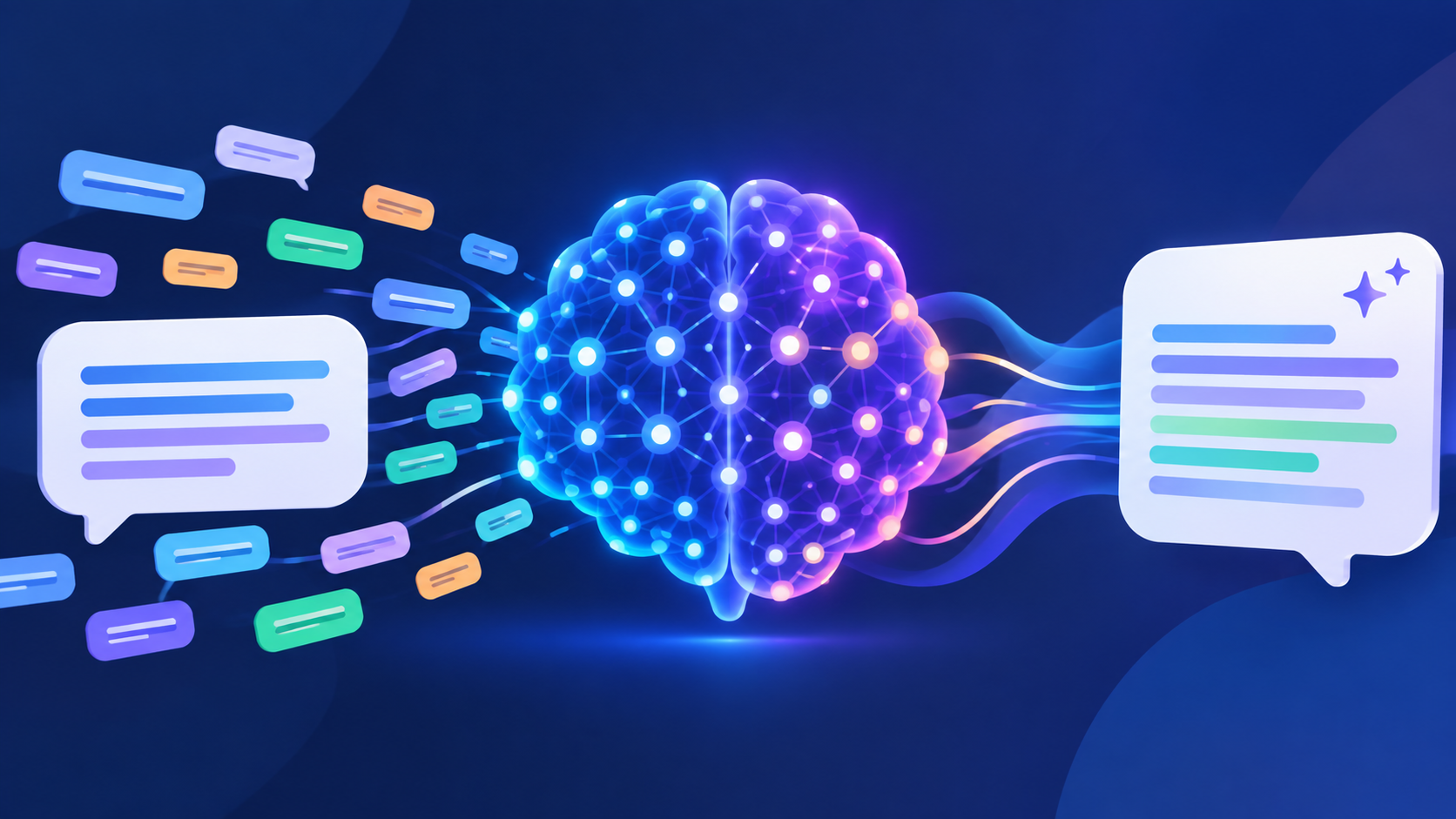
If you have used ChatGPT, Claude, or Gemini, you have already talked to a large language model. But what is actually happening behind the scenes when you type a question and a fluent, human sounding answer appears seconds later? The honest answer is less magical than it feels, and once you understand the basic idea, it actually makes a lot of sense. Let’s break it down without the jargon.
The Simple Definition
A large language model, or LLM, is a computer program trained on an enormous amount of text so it can predict what word is most likely to come next in a sentence. That’s it. That is the entire core idea. Everything else, the fluent conversations, the essays, the code, the poetry, all of it comes from that one simple skill repeated over and over, one word at a time.
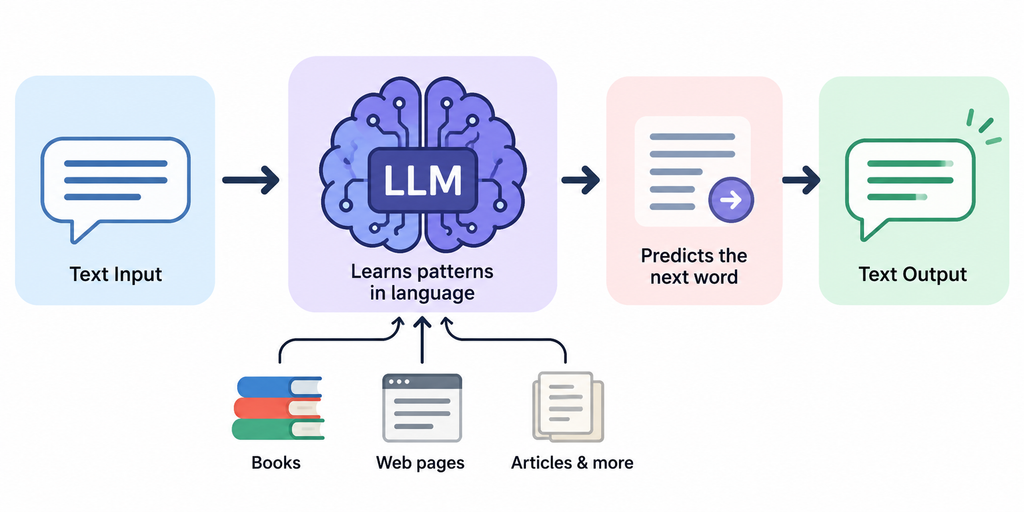
Think about how your phone’s keyboard suggests the next word when you’re texting. An LLM does the same basic thing, just at a massive scale and with a far deeper understanding of context, grammar, and meaning.
How Does It Learn to Do That?
To get good at predicting the next word, an LLM has to read a staggering amount of text first, billions or even trillions of words pulled from books, websites, articles, and other publicly available writing. This stage is called training, or pretraining.
During training, the model is essentially playing a constant fill in the blank game. It looks at a sentence with the last word hidden, guesses what that word should be, checks how wrong or right its guess was, and then slightly adjusts itself to do better next time. Multiply that process by billions of examples, and the model starts to pick up on the deep patterns of language: grammar, common phrases, how ideas connect, and even some real world facts, simply because those patterns show up over and over in what it read.
It is worth being clear about something here. The model is not memorizing the internet like a filing cabinet. It is learning statistical patterns, essentially building an internal sense of which words tend to follow which other words, in which contexts. That is why it can write about topics in ways that were never written exactly like that before. It is remixing patterns it has absorbed, not copying and pasting from a database.
The Breakthrough That Made This Possible: Transformers
For a long time, language models struggled with one big problem: understanding context. Words can mean very different things depending on what surrounds them. Consider the word “bark.” Is it a dog barking, or the bark of a tree? A model needs the surrounding words to figure that out.
In 2017, researchers introduced an architecture called the transformer, and it changed everything. The key innovation inside a transformer is something called self attention. In plain terms, self attention lets the model look at every word in a sentence and figure out how strongly it relates to every other word, no matter how far apart they are in the sentence.
Take this sentence as an example: “The alien landed on earth because it needed to hide on a planet.” When the model processes the word “it,” self attention helps it figure out that “it” almost certainly refers back to “the alien,” not to “earth” or “planet,” because of how those words relate to each other across the sentence. This ability to connect distant, related words is what allows LLMs to understand context far better than earlier systems ever could, and it is a big part of why they feel so much more coherent and natural than older chatbots.
From Predicting Words to Holding a Conversation
A raw, freshly trained language model is really good at continuing text, but it is not naturally good at following instructions or being a helpful assistant. If you typed “Write an essay about Alexander Hamilton,” an untrained model might just continue that sentence the way it appeared in its training data, rather than actually writing the essay.
To fix this, developers add extra training steps after the initial pretraining:
Instruction tuning teaches the model to actually respond to requests the way a helpful assistant would, rather than just continuing text in a generic way. Developers show it many examples of prompts paired with the kind of response a person actually wants.
Reinforcement learning from human feedback, often shortened to RLHF, goes a step further. Real people review multiple possible responses from the model and rank which ones they prefer. The model is then nudged toward producing more of what people rated highly and less of what they rated poorly. This is a big part of why tools like ChatGPT and Claude feel noticeably more polished, safe, and genuinely helpful than a plain, untuned language model would.
What Large Language Models Are Actually Good At
Once trained, LLMs can be applied to a wide range of tasks, including:
- Answering questions and holding conversations
- Writing and summarizing text, from emails to entire reports
- Generating and debugging code
- Translating between languages
- Analyzing sentiment in reviews or feedback
- Explaining complex topics in simpler language
They are especially good at tasks that involve a lot of variety, because they’ve effectively seen billions of examples of similar tasks during training, whether that’s answering trivia, writing a cover letter, or fixing broken code.
Where Large Language Models Fall Short
As impressive as they are, LLMs have real limitations worth understanding, especially before relying on them for anything important.
They can confidently make things up. This is called hallucination, and it happens when the model generates information that sounds plausible but is actually false. Because the model is fundamentally guessing the most statistically likely next word rather than checking a database of facts, it has no built in way to know when it’s wrong.
They don’t actually “know” what’s true. An LLM doesn’t hold beliefs or have a concept of truth the way a person does. It generates whatever text pattern seems most likely given the input, which means it can be prompted to argue either side of an issue with equal fluency, regardless of which side is actually correct.
They can reflect biases from their training data. Since LLMs learn from enormous amounts of text scraped largely from the internet, they can absorb and repeat stereotypes, misinformation, or skewed perspectives that were present in that data.
They don’t truly remember previous conversations. Within a single conversation, the model can seem to “remember” earlier messages, but that’s really because the entire conversation history is being fed back in as part of the input each time. Once a conversation ends or gets too long, that context is gone.
They require real fact checking for anything important. For low stakes tasks like brainstorming or drafting a casual email, small mistakes barely matter. For anything with real consequences, medical information, legal questions, financial decisions, always verify what an LLM tells you against a reliable source.
A Simple Way to Think About It
Here’s a mental model that tends to stick. When a large language model gives you a surprisingly good answer, the right reaction isn’t “wow, this thing is truly thinking.” A more accurate reaction is “I probably asked it to do something similar to things it has seen many times before.” That’s not meant to be dismissive. It’s genuinely useful, because so much of what we ask for in everyday life, drafting an email, explaining a concept, summarizing an article, closely resembles things humans have already written many times over. The model has simply absorbed an enormous library of those patterns and become remarkably skilled at recombining them to fit your specific request.
The Bottom Line
A large language model is, at its core, a very sophisticated next word predictor, trained on a massive amount of text and refined with human feedback to be genuinely helpful. It doesn’t think or understand the way a person does, but by learning the deep statistical patterns of human language, it has become capable of writing, explaining, coding, and conversing in ways that feel remarkably natural. Understanding that core mechanism doesn’t make the technology any less useful. If anything, it helps you use it more effectively, and know exactly when to double check what it tells you.